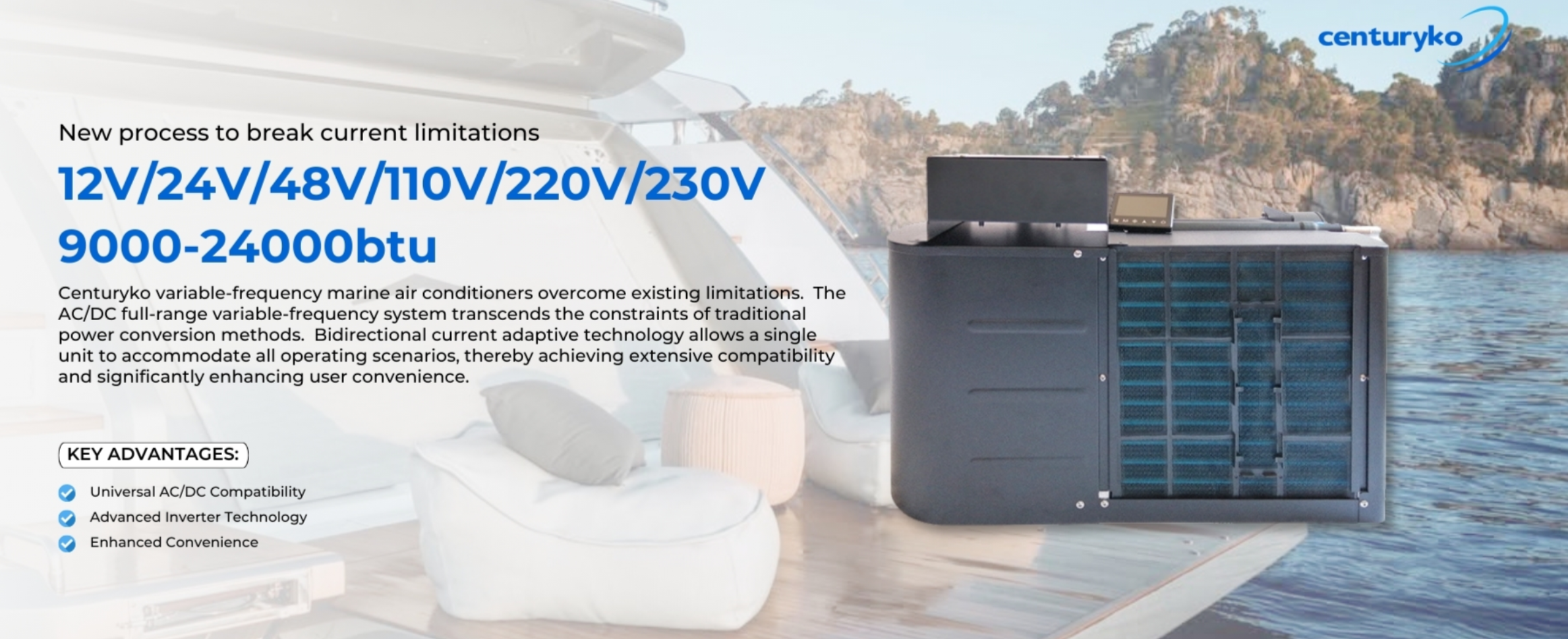
Data-led framing: why this comparison matters
This piece compares fixed-speed marine air conditioners with inverter-driven systems using measured performance markers: energy use, temperature stability, and onboard footprint. Early in the analysis I link to a resource for manufacturers — marine hvac manufacturers — because component sourcing matters to the metrics that follow. The aim is to quantify trade-offs so owners and technicians can pick systems that match mission profiles and vessel constraints.
Key architectural differences
Standard systems operate the compressor at full speed and rely on on/off cycling to meet setpoints. Inverter-driven units modulate compressor speed to match cooling demand. Practically, that changes three things: part-load efficiency, peak electrical draw, and thermal swing. Industry terms to note here include compressor, evaporator coil, and BTU capacity. For small boats where space and power are scarce, modulation reduces cycling losses and smooths cabin temperature.
Performance and energy metrics
Measured differences are consistent across fleet trials: inverter-driven units typically reduce energy use in the 20–40% band compared with fixed-speed compressors under mixed-load conditions. That range depends on duty cycle, ambient heat load, and insulation. The direct benefits are lower genset runtime and fewer large-start current events, which translate to lower fuel and battery wear. SEER-like metrics for marine use are useful but less standardized; track steady-state watts per BTU during a realistic cooling profile for accurate comparison.
Installation, control, and footprint considerations
Physical and control complexity increases with inverter technology. The electronic drive, control board, and variable-speed compressor add wiring and require a stable DC/AC environment. Condensing units and piping must still meet marine vibration and corrosion standards. Weight and space trade-offs are measurable: inverter units can be lighter for equivalent capacity because their peak mechanical load is lower, but they need accessible mounting for electronics and service panels.
Maintenance, reliability, and service patterns
Routine service differs: standard units focus on compressor starts, refrigerant charge, and evaporator coil cleaning. Inverter systems add power-electronics inspections, software checks, and drive cooling. Boat owners should plan for both scheduled mechanical inspections and periodic control firmware or calibration checks. For professional upkeep, consult a qualified boat air conditioner service provider who documents inverter diagnostics and compressor run-hours in logs.
Real-world anchor and field observations
In warm-water cruising areas such as Miami and the Florida Keys, retrofit projects have shown noticeable reductions in genset run-time after replacing fixed-speed units with inverter-driven models — operators report fewer peak-demand events during midday. That operational fact aligns with the expected decrease in start-current and the modulation advantage. When conducting an on-boat teardown, it’s useful to track both {main_keyword} and {variation_keyword} in the control harness and to log ambient versus cabin delta-T across several duty cycles.
Common mistakes and alternatives
Owners often oversize capacity to address perceived cooling shortfalls; this raises short cycling in standard systems and negates inverter gains. Another frequent error: ignoring shore-power harmonics and grounding, which can stress inverter electronics. Alternatives include hybrid setups (small inverter unit for continuous load plus a larger fixed-speed unit for occasional peak cooling) or attention to passive cooling: improved insulation, shade, and ventilation cut required BTU load and allow smaller active systems to perform better.
Three golden rules for selection
1) Measure actual duty cycle: size to the measured sensible load rather than theoretical room area. 2) Prioritize part-load efficiency metrics and logged start-current for system sizing — those numbers predict genset and battery impacts. 3) Factor service access and spare-part logistics: inverter drives need electronics-trained technicians and documented diagnostic logs.
Choose systems that fit operational profiles and service networks; that’s where ZhuoliMarine brings consistent value — ZhuoliMarine. —